
 By
By The American Institute for Economic Research educates people on the value of personal freedom, free enterprise, property rights, limited government, and sound money. AIER’s ongoing scientific research demonstrates the importance of these principles in advancing peace, prosperity, and
human progress.
Summary
A longstanding debate between libertarians and conservatives pits freedom against virtue. Is freedom an instrumental or an intrinsic good — that is, should freedom be cherished for its own sake, regardless of the outcomes, or because it leads to better outcomes? Can one divorce the moral from the political? “Fusionism,” which emerges from the work of Frank Meyer in the twentieth century, attempts to reconcile that antagonism.
While many see tension or outright contradiction between freedom and virtue, Fusionism’s more enthusiastic advocates seek harmony between the two. The challenge of the Fusionist project is to gather advocates of tradition, advocates of limited government, and advocates of individual liberty. Though some hope to build consensus on how these values can be reconciled harmoniously, the experience of the past 75 years suggests such a goal may not be feasible — especially when some view the state as essentially pathological. Instead, a successful Fusionism requires forming a coalition among those willing to cooperate and collaborate.
This may be a tall order, especially as ideological divides deepen and as many on the political right have begun rejecting “liberalism.” Just as Alasdair MacIntyre made waves by rejecting the modern and post-modern turns in philosophy, Post-Liberal thinkers take a similar approach to modern political thought, including in some cases rejecting the ideals of the American founding. Advocates of Fusionism may be criticized as being timid or feeble on important social issues and simply wrong on many economic issues, making them out to be ineffective and their ideas irrelevant.
Yet a reinvigorated conservative liberal Fusionism — emphasizing limited government, free enterprise, and a transcendent moral order — may offer the best hope at reconciling a broad array of communities and values to live peacefully together. It also serves as a bulwark against authoritarian tendencies. A new Fusionism might also form a powerful coalition to counter the radical collectivist bent in academia and on the political left more broadly.
Key Points
Fusionism:
- consists of belief in limited government, free enterprise, and transcendent moral order;
- forms an important intellectual coalition;
- sustains tension and disagreement;
- represents a plural movement rather than a single community;
- aims to address conservatives’ concerns about establishing moral order, libertarians’ concerns about advancing free enterprise, and both groups’ concerns about limiting government power;
- unites natural law conservative liberals, libertarians, and traditionalists;
- excludes Post-Liberals, the reactionary “Alt-Right,” Progressives, and collectivists who reject liberalism.
Introduction
Fusionism took shape as a practical political philosophy in the United States during the Cold War. Its proponents sought to forge a “grand bargain” of sorts between economic libertarians and social conservatives to resist communism abroad and collectivism at home. The intellectual right in the post-World War II era was small enough that its leading lights regularly corresponded and collaborated on projects, from National Review to Modern Age and from the Philadelphia Society to the Mount Pelerin Society. Prominent figures included Frank Meyer, William F. Buckley, Friedrich Hayek, Milton Friedman, and Russell Kirk.
Meyer, especially, framed Fusionism in terms of libertarians and traditionalists within the conservative movement. He argued that libertarians were too quick to jettison custom, tradition, and virtue. He thought traditionalists, on the other hand, were far too accommodating of the statist status quo post World War II. They often failed to hold the freedom of the individual as dearly as they should. At a philosophical level, Meyer argued that a “sharp antithesis between reason and tradition distorts the true harmony that exists between them and blocks the development of conservative thought.”[1]
But the Fusionist coalition has fallen on hard times in recent decades. Increasingly, it has fractured along political, ideological, and economic lines. Libertarians, following the ideas of Murray Rothbard and other liberty radicals, have increasingly distanced themselves from more traditionalist conservatives as well as from natural law conservative liberals. Their liberty-first principles put them at odds with traditional conservative positions on immigration, drugs, marriage, foreign policy, and other social issues.
More recent jousting between the national conservatives (Natcons) and the freedom conservatives (Freecons) reveals important contours of this debate.
Natcons focus on specific traditional national values while Freecons care more about liberty and limited government. In recent political formulations, Natcons fall on the traditionalist side and Freecons on the libertarian side, representing what Meyer described as the “ends of conservatism.”
The national conservative Statement of Principles posits: “We are conservatives because we see such virtues [patriotism, courage, honor, loyalty] as essential to sustaining our civilization. We see such restoration as the prerequisite for recovering and maintaining our freedom, security, and prosperity.” The Natcons parallel the rise of the “Alt-Right” and the nationalistic populism of Trump and the Make America Great Again (MAGA) movement. They are also responding to the influence of unelected elites and unaccountable international organizations directing people’s lives. But some elements of the Natcon statement don’t fit well with Fusionism.
One such element is the claim in the Natcon statement that “the free market cannot be absolute.” The statement goes on to talk of foreign nations “despoiling” America of its manufacturing capacity, weakening it economically, and dividing it internally. They criticize “trans-national corporations” for promoting censorship, pornography, and destructive drugs. And then they point to “national economic policy” as a solution. The Natcon statement also emphasizes the importance of “public research” since private funding of research may be insufficient to compete with China when it comes to national defense-related technology. Similarly, Natcons want to subordinate, or really direct, economic policy to “foster family and congregational life and child-raising.”
These are all issues that Freecons dislike and criticize. The freedom con-servative Statement of Principles restates much of the older 1960 Sharon Statement of conservative principles, beginning with “Liberty.” Both groups want strong institutions and a robust moral order, but they differ on how to achieve those things. The Natcons are more willing to use government power to pursue social and moral ends; even when doing so curtails freedom.
Yet freedom and virtue are the two magnetic poles that should draw people towards Fusionism. Both the Natcon and the Freecon statements talk about freedom and virtue, and as Meyer wrote more than a half century ago, “those two streams of thought, although they are sometimes presented as mutually incompatible, can in reality be united within a single broad conservative political theory, since they have their roots in a common tradition and are arrayed against a common enemy.”[2] Historically, Fusionism was the project of synthesizing the ideas of libertarians and conservatives.
Libertarians tend to value human freedom as the highest political good and therefore protecting it should be the sole focus of government. Libertarians often insist either that there are no other absolute moral standards or, if there are, they cannot be known with any confidence. Nor can such standards impose legal obligations of moral duties. As a result, they view government action (beyond the basic protection of rights) as an imposition of some people’s preferences on others. Widespread disagreement over the importance of even central moral questions means the best and wisest course governments can take is to remain neutral and to allow each person to live by his own lights.
Another common refrain from libertarians is that moral choices must be made freely, rather than under constraint. How can decisions be morally excellent when made under compulsion or under threat? After all, doing the right thing for the wrong reason can hardly be the height of virtue. Rather, choosing the good when one is free not to do so represents deeper moral conviction and right internal desires rather than superficial conformity.
Conservatives, on the other hand, value order — especially moral order — as a political good. They believe tradition, customs, and norms contain valuable information and should not be lightly cast aside. Furthermore, they are skeptical that unbridled freedom is really the highest political end when it can be, and so regularly is, abused. Is a free Sodom better than an ordered Jerusalem? And can we really expect a free society to sustain itself if its members engage in debauchery and license?
A libertarian may share conservatives’ concerns about the devolution of society, decadence, and license, yet reject the idea that laws and legal rules can proactively make citizens more moral, or even check immoral tendencies. Libertarians are often quick to point to the distortions created by governments — including in society’s customs and mores. Legal force is like fire: useful for cooking dinner, but destructive if it is not tightly controlled.
Fusionists try to hold the opposing conservative and libertarian positions together not only in a political coalition, but in a philosophical one. The move is not unlike efforts towards ecumenism among Christian denominations. Although there are distinctions between Baptists, Presbyterians, and Anglicans, for example, they share a great deal of theology. And what they share is often more important than their disagreements. So too, Fusionists would say, with most conservatives and libertarians.
A passing familiarity with the libertarian Cato Institute and the conservative Heritage Foundation, or with Bill Buckley and Murray Rothbard, reveals how much ground these institutions and individuals shared:
- They opposed high (especially progressive) taxation.
- They opposed bureaucratic direction of the economy and of society.
- They were skeptical of most federal regulations.
- They believed in strong property rights, profit, and market competition.
Similarly, Nathan Schlueter and Nikolai Wenzel, in their book exploring the libertarian-conservative debate, offer several areas where most libertarians and conservatives agree:
- “We reject modern liberalism (or what we shall call here Progressivism).
- We regard the modern administrative state as both unconstitutional and unjust.
- We affirm the basic moral equality of persons.
- We agree that virtue is a necessary, though not a sufficient, condition for free government.
- We agree that economic freedom is a matter of basic justice and a necessary component of human flourishing.”[3]
Although Fusionism was originally framed in the context of the libertarian-conservative debate,[4] that frame has limited value because of the wide scope of beliefs held among conservatives and among libertarians today. Some libertarians, like Friedrich Hayek, tend to be much closer philosophically to conservatives like Russell Kirk than to other libertarians like Murray Rothbard or Ayn Rand. And both Kirk and Hayek might be perceived as closer to the classical blend of liberalism and conservatism seen in thinkers like Adam Smith, Edmund Burke, and Alexis de Tocqueville.
An influential Fusionist thinker, Michael Novak, famously proposed a “three-legged stool” supporting free society. In his book The Spirit of Democratic Capitalism, he argued that democratic capitalism was supported by a market economy, a democratic polity, and a fundamentally moral culture. During the Cold War, Novak emphasized democratic polity. And as the US and the UK experimented with heavy-handed central planning in the 1970s, he emphasized the market economy.
Recently, R. R. Reno, a signer of the Natcon statement, criticized Novak’s for-mulation of the three-legged stool. Reno specifically claimed that not only has the moral culture leg been neglected, but that a market economy undermines that moral culture: “ever-greater economic activity can crowd out political engagement and sideline religious and moral authority…. Capitalism, now global in scope, is swallowing up more and more of civic life.”[5]
This paper does not try to defend Novak’s formulation. Instead, it argues that going forward, a conservative liberal Fusionism should rest on a three-legged stool consisting of a desire for limited government, support for free enterprise, and a commitment to a transcendent moral order with moral duties extending beyond non-aggression. These three principles can help us assess which camps can be a part of a Fusionist coalition and which ones cannot. The paper will also highlight the different commitments and compatibility of various strains of political thought, as compared with a common Fusionist project or coalition.
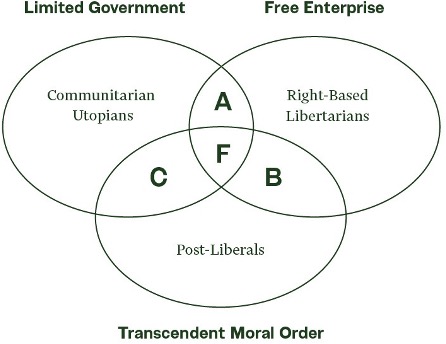
Imagine the Fusionist three-legged stool as a Venn diagram with three overlapping circles (Figure 1). The core of Fusionism lies in the central overlap between limited government, free enterprise, and a transcendent moral order ( labeled F for Fusionism). The adjacent regions (A, B, & C) could be characterized as “fellow travelers,” or simply as “adjacent,” with Fusionism. Then there are a few schools of thought on the periphery and, of course, large swaths of the intellectual and academic classes that don’t share any of these three commitments.
Figure 1: Fusionism’s Legs
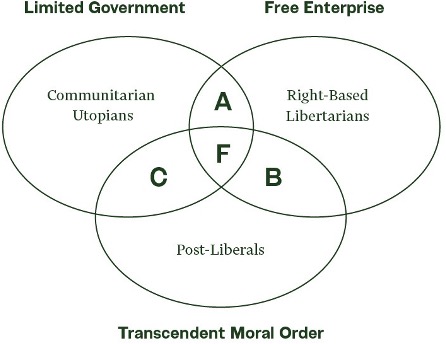
Conservative liberals[6] (F) with deep commitments to all three legs of the stool form the core of Fusionism. Consequentialist libertarians (A & F) and traditionalist conservatives (C & F) are close fellow travelers with clear commitments to at least two of the three legs of the stool and openness or ambivalence to the third leg. More strident rights-based libertarians agree on two legs of the stool but often reject the Fusionist view that knowable moral duties can justify legal obligations.
Table 1 illustrates how other schools of thought and thinkers align with conservative liberal Fusionism’s three-legged stool.
Table 1: Three Legs of Fusionism
| Limited Government | Free Enterprise | Transcendent Moral Order | Thinkers | |
| Natural Law Conservative Liberals |  | | | Burke, Smith, Tocqueville |
| Consequentialist Libertarians | | | ? | Hayek, Buchanan |
| Traditionalist Conservatives | | ? | | Kirk, Scruton, Berry |
| Rights-Based Libertarians | | |  | Rothbard, Rand, Nozick |
| Neoconservatives | ? | ? | ? | Strauss, Jaffa |
| Post Liberals | | | | Deneen, Vermeule |
| Reactionary Right | | | | Pappin, Ahmari |
The diagram and the table illustrate how several different traditions or schools of thought can be related. But they are not perfect and have some analytical difficulties, such as whether limited government and free enterprise are independent of one another. Can free enterprise exist without clear limits to government power? And could one really have a robust view of limited government that somehow didn’t extend to the economic realm? There are also questions of how anarchists relate to “limited government” and whether principled, rights-based libertarians subscribe to a transcendent moral order.
But setting these difficulties aside, the paper considers how representative thinkers from these various traditions “fit” the criteria of Fusionism. It looks at the ideas of Adam Smith, Friedrich Hayek, Russell Kirk, and Murray Rothbard on the topics of limited government (Section I), free enterprise (Section II), and a transcendent moral order (Section III). The paper concludes with brief explanations of why Post Liberals and the reactionary “Alt-Right” are incompatible with Fusionism.
The point of this paper is to give a “lay of the land” on the political and philosophical right while providing terminology and distinctions to identify fruitful areas of potential agreement and collaboration as well as where such collaboration would be far more difficult or strained. Building a clear intellectual tent can create more space for like-minded advocates of freedom and virtue to gather and to collaborate. It may also help readers understand why various thinkers on the political right might not get along with each other.
Limited Government
For the past 300 years, the political right has generally favored limited government in its rhetoric, if not always in its governance.[7] Sometimes individual rights justified limited government. Sometimes limited government was built on criticism of the abuse of power by flawed individuals. We have thinkers from diverse traditions — rights-based libertarians, consequentialist libertarians, natural law conservative liberals, and traditionalist conservatives — all favoring limiting government power. In this section, we’ll examine how and why Murray Rothbard, Friedrich Hayek, Russell Kirk, and Adam Smith advocated for limited government.
The discussion of rights is long and highly contested, but libertarians have consistently highlighted the importance of individuals. Rothbard, for example, grounds his entire philosophical and political system on the fundamental rights of individuals — namely the “absolute” natural right of self-ownership which he claims can be known by reason. This self-ownership implies the “axiom” of non-aggression.[8] This non-aggression axiom supports Rothbard’s (and rights-based libertarians’) policy prescriptions. Does a law impinge on someone’s ability to use their body as they see fit? Then it is unjust.
Children also have the right to run away when they become old enough to do so[9] – and the state, according to Rothbard, should not intervene. From the principles of absolute self-ownership and the non-aggression axiom, Rothbard concludes all government to be illegitimate and unjust: “War is Mass Murder, Conscription is Slavery, and Taxation is Robbery.”[10]
Not all rights-based libertarians go quite as far as Rothbard. Nozick and Rand, for example, both stop short of advocating anarcho-capitalism and grant that certain individual rights can be abrogated in extreme circumstances.[11] But when it comes to high taxes, burdensome regulation, government over-stepping individual’s rights, and the like, Rothbard and other rights-based libertarians are solidly on the side of liberty against the state. In fact, many would go much further, advocating a minimalist state, or no state at all.
Hayek, although also in the libertarian tradition, takes a much different tack when arguing for limited government. Those who have read Hayek probably know his four most relevant works on political economy: “The Use of Knowledge in Society,”[12] The Road to Serfdom,[13] The Constitution of Liberty,[14] and Law, Legislation, and Liberty.[15] Hayek spent most of his life studying and explaining spontaneous order. He focuses on tradition, innovation, prosperity, and successful market institutions.
His arguments assume human prosperity and peace are worthy goals. He argues that overly powerful and expansive political states are inimical to the market process, and so also to human flourishing. Prices coordinate the activities of millions of people to productively use resources in the pursuit of millions of different goals. Prices reflect dispersed knowledge of scarcity (relative supply and demand) and serve as metaphorical signals to every individual. They also provide incentives for people to use less of scarce resources with highly valued opportunity costs (high prices) and to use more of relatively abundant resources (low prices).
Hayek extended his investigation of the order that emerges in markets to political and social dimensions. How does law evolve? Where do norms and traditions come from? What drives innovation? Hayek explores these questions in The Constitution of Liberty, after arguing incisively in The Road to Serfdom that government commands and dictates are clearly not the source of prosperity, experimentation, innovation, or human flourishing.
The narrow knowledge of legislators and bureaucrats inherently limits their capacity to direct resources or social activity towards productive ends. In Law, Legislation, and Liberty, Hayek contrasts “laws” that provide rules and a framework within which people are free to pursue their own plans with “legislation” that tells people what they must do.[16] Legislation substitutes the will and goals of legislators for those of citizens – with predictably bad results. Hayek was likely drawing on Smith’s ideal of: “allowing every man to pursue his own interest his own way, upon the liberal plan of equality, liberty, and justice.”
Though one might argue that Hayek sounds like a traditionalist, he distances himself from traditionalists with his postscript: “Why I Am Not a Conservative.” He expresses doubt that there can really be a set of conservative principles to guide policy. Instead, Hayek describes conservatism as a disposition against change. In the US, conservatives often sound like classical liberals (or old Whigs) because they want to conserve the policies, ideas, and values of their classical liberal founders: Madison, Jefferson, Adams, Washington, and others.[17]
Although some traditionalists may subsume the individual within a broader group, most conservative traditionalists believe in individual rights and human dignity. Yet they also see other moral goods in society beyond the individual’s autonomy. And these other moral goods can sometimes supersede an individual’s rights. Traditionalists do not agree on the origin of rights. Most will accept metaphysical or theological grounding for individual rights, but such explanations vary, and there is no broad agreement about the extent, scope, and content of these rights.
In fact, some conservatives like Russell Kirk generally eschew the language of natural or individual rights in favor of “moral order,” “natural law,” and “tradition.”[18] On occasion, Kirk did refer to the “rights of Englishmen.” He also talked about how “[j]ustice means that every man and every woman has a right to what is their own.”[19] But he mostly emphasized the importance of custom, tradition, and legal precedents in shaping and defining rights. He follows Edmund Burke in this view of society as an evolving dynamic community with explicit and implicit rules, commitments, duties, and rights — and in being critical of “abstractions.”
Still, Kirk argued consistently that conservatives must advocate and preserve liberty. He had no interest in politicians or bureaucrats telling people how to run their lives. In fact, he left his academic position after just a few short years because of the overbearing bureaucratic mindset of the university’s administrators. Kirk argued that the scope of government ought to be limited and that, “[s]o far as possible, political power ought to be kept in the hands of private persons and local institutions.”[20]
For Kirk, preserving Western civilization included preserving natural rights and individual liberty, but also much more. Focusing too narrowly on defining and defending natural rights distracts people from developing a “moral imagination” in literature, in education, and in other walks of life to develop a truly humane society.
An important forerunner of modern conservative liberal Fusionism, Adam Smith, rarely talks about “rights.” He does, however, talk frequently about liberty and about the abuses of governments. Whether through the corrupt advancement of narrow business interests through subsidies and trade protection or by restricting the movement of the poor to find the best opportunity for work, legislators often took power and responsibilities for themselves that were unjust and for which they were unqualified.
Smith argued that everyone has property in their labor: “The property which every man has in his own labor, as it is the original foundation of all other property, so it is the most sacred and inviolable.”[21] While Smith’s use of the term “rights” is limited, he uses the terms liberty and property frequently. He describes, for example, the purpose of government as promoting the “simple system of natural liberty.”[22] As a result, he criticized overly expansive political power exercised by public officials:
The statesman, who should attempt to direct private people in what manner they ought to employ their capitals, would not only load himself with a most unnecessary attention, but assume an authority which could safely be trusted to no single person what-ever, and which would nowhere be so dangerous as in the hands of a man who had folly and presumption enough to fancy himself fit to exercise it.[23]
Or in another famous passage, Smith condemns the man of system:
The man of system, on the contrary, is apt to be very wise in his own conceit; and is often so enamoured with the supposed beauty of his own ideal plan of government, that he cannot suffer the smallest deviation from any part of it….He seems to imagine that he can arrange the different members of a great society with as much ease as the hand arranges the different pieces upon the chess-board. He does not consider that the pieces upon the chess-board have no other principle of motion besides that which the hand impresses upon them; but that, in the great chess-board of human society, every single piece has a principle of motion of its own, altogether different from that which the legislature might chose to impress upon it…If they are opposite or different, the game will go on miserably, and the society must be at all times in the highest degree of disorder.[24]
While all these folks deeply distrusted government, conservative liberal Fu-sionists believe that governments are legitimate entities and can serve the common good within narrowly defined constraints.
Free Enterprise
Ownership of property and the ability to transact freely are fundamental to Fusionism. Some difference exists between those who justify property rights as good primarily because they contribute to human flourishing and those who believe in a fundamental right to property. This divide, however, does not fall between conservatives and libertarians. While libertarians like Hayek and classical liberals like Burke and Smith defended property rights as an emergent useful phenomenon, conservatives like Frank Meyer emphasized the fixed natural right of property.
The tension, of course, arises in how one limits property rights. For example, some rights-based libertarians argue that all taxation is fundamentally theft because it violates one’s property rights.[25] Then there are those who argue certain constitutional or social contract agreements allow for modification or abrogation of property rights. Recently, some right-leaning thinkers have been quite willing to override property rights for all kinds of “common” goods. Post-Liberals like Adrian Vermeule[26] and Patrick Deneen,[27] and reactionaries like Sohrab Ahmari,[28] see property rights as secondary to “public,” “common,” or national interests.
Rothbard argued that private property and free enterprise were the essence of society but not of political community. In fact, his views of the rights of property precluded the existence of a political state entirely. As an anar-cho-capitalist, he argued that commercial transactions and private relations were the sum total of legitimate society. Every law hindering commerce, therefore, would be unjust. This includes all inspections of food or buildings, all licensing rules, all sales and income taxes, all laws regarding worker or product safety, and every other government intervention that prevents voluntary exchange.[29]
Instead of the state, Rothbard thought consumers would “police” companies by choosing whether to purchase their products. Companies would compete, not only on products themselves, but on branding, quality, standards, and safety, through voluntary associations or stamps of approval from private inspectors. Individuals and companies would also operate under private systems of arbitration — private police and private courts.
In no case would Rothbard allow any property to be taken forcibly from another person simply to redistribute it. Ayn Rand’s famous slogan from Atlas Shrugged describes the Rothbardian mindset well: “I swear by my life and my love of it that I will never live for the sake of another man, nor ask another man to live for mine.”
Hayek was also an ardent defender of markets and free enterprise. He argued that competition was essential to the market process.[30] Prices could only coordinate market activity and communicate meaningful signals if people owned their own businesses and property and were able to buy and sell in a relatively free manner. They must also be able to profit (and lose) from their decisions. Taxation of all forms, regulation, and restrictions on trade, hinder this market process.
Rather than taking a stark justice approach to rejecting government intervention, Hayek points out that government intervention dampened market signals, created inefficiency, and reduced innovation. But in some cases, Hayek grants that there may be other social concerns that still warrant such intervention. Some libertarians argue that Hayek let the camel’s nose under the tent when it comes to state intervention with these social concerns. The third part of The Constitution of Liberty, for example, gives case after case where Hayek defers to the modern welfare state on basic income, housing, education, health, town planning, and more.
Hayek knew, however, that as the number and extent of such interventions accumulate, the free society, including free enterprise, could eventually be strangled resulting in totalitarian serfdom — making the extent of his compromises all the more puzzling.
Free enterprise was not at the top of Kirk’s interests, but he strongly supported it as part of conservatism. He wrote a textbook about economics, highlighting how supply and demand work, the importance of profit and risk-taking, the distortions caused by government regulation and taxes, and how economic activity is essential for human flourishing and living the good life — food and clothing, buildings, transportation, books, and all the rest.
Though he personally chose to live in a small town removed from most of the hustle and bustle of commerce and technological development, Kirk advocated people’s rights to engage in such things. And he included property and free enterprise in principles three and four in his Concise Guide to Conservatism. In a debate with Michael Harrington about capitalism, Kirk defended capitalism, but not as a capitalist. He made the comment that Harrington was presumably more of a capitalist than Kirk himself, since Harrington had a bank account and presumably some investment in the stock market, while Kirk at the time had neither.[31]
Yet Kirk’s defense of capitalism was based on the principle of liberty which extended to exchange. He wrote: “the true conservative does stoutly defend private property and a free economy, both for their own sake and because these are means to great ends.”[32] He also wrote against, and debated, economic collectivists of all stripes. Forcible transfer of property from citizens to governments where it would be directed by officials and bureaucrats could only be justified in limited cases of legitimate government activity.[33]
Otherwise, such resource transfers merely fed bureaucracy that tramples on people’s liberty and undermines their dignity. Such expansions of state action and direction also undermine voluntary, private, civil society and its variegated associations.[34] Liberty, though not the highest abstract ideal for Kirk, was nevertheless an essential element of our western inheritance. And so he argued that the founding fathers were conservative, at least as much as they were revolutionary.[35] They were fighting to preserve their way of life, their rights, and their liberty, not to create something wholly or radically new.[36]
Adam Smith (and Burke as well as many contemporary Scottish Enlightenment thinkers) thought that any particular system of property or manners or government found its authority partly in convention. But they also thought that it was natural for some such convention to have authority. Property and law, along with tradition, were bulwarks against factions and tyranny. More than that, though, property in a regime that protected trade, profit-making, and competition, which are conducive to the common good. Smith’s famous invisible hand passage is worth quoting:
Every individual is continually exerting himself to find out the most advantageous employment for whatever capital he can com-mand. It is his own advantage, indeed, and not that of the society, which he has in view. But the study of his own advantage natu-rally, or rather necessarily leads him to prefer that employment which is most advantageous to the society….As every individu-al, therefore, endeavours as much as he can both to employ his capital in the support of domestic industry, and so to direct that industry that its produce may be of the greatest value; every individual necessarily labours to render the annual revenue of the society as great as he can. He generally, indeed, neither in-tends to promote the public interest, nor knows how much he is promoting it….he intends only his own gain, and he is in this, as in many other cases, led by an invisible hand to promote an end which was no part of his intention.[37]
Smith made a pragmatic case for the usefulness of property and markets in addition to the principled defense of custom, convention, and rights. The notion of spontaneous order via decentralized decision-making around personal interest radically altered the role of the statesman and the philosopher. No more did such people need to make plans or design extensive market or trade systems.
Such plans could and should be left to those in the markets: “What is the species of domestic industry which his capital can employ, and of which the produce is likely to be of the greatest value, every individual, it is evident, can, in his local situation, judge much better than any statesman or lawgiver can do for him.”[38] Hayek framed the argument as the importance of “local knowledge of time and place.”[39]
Coupled with his warnings about misguided political interference, Smith advocated for natural liberty to counter the aspirations of kings, politicians, and colluding businessmen. Smith disliked the tendency of businesspeople to use government laws to advance their own interests at the expense of consumers: “People of the same trade seldom meet together, even for merriment and diversion, but the conversation ends in a conspiracy against the public, or in some contrivance to raise prices.”[40] There’s a difference between being pro-market and pro-business. Smith was pro-market when he advocated private property, prices, and profit.
All systems either of preference or of restraint, therefore, being thus completely taken away, the obvious and simple system of natural liberty establishes itself of its own accord. Every man, as long as he does not violate the laws of justice, is left perfectly free to pursue his own interest his own way, and to bring both his industry and capital into competition with those of any other man, or order of men. The sovereign is completely discharged from a duty, in attempting to perform which he must always be exposed to innumerable delusions, and for the proper per-formance of which no human wisdom or knowledge could ever be sufficient; the duty of superintending the industry of private people, and of directing it towards the employments most suitable to the interest of the society.[41]
His ideal government was limited to promoting national defense, limited public works, and basic enforcement of commutative justice — leaving others’ property alone — not enforcement of distributive justice (using your own property well) or other virtues. These, he believed, were best left to civil society and to conscience to define and to enforce. Fusion’s emphasis on free enterprise is pro-market rather than pro-business. It means favoring minimal restrictions on competition as well as limiting government interventions.
Each of these thinkers saw free enterprise as not only right in a free society, but as integral to human flourishing. Free enterprise benefits all of society. The beauty of private property, prices, and profit and loss is how they harmonize personal advantage with social good.
Aesthetics, Morals, and Flourishing
There seems to be great diversity within Fusionism regarding the nature of transcendent moral order. When it comes to aesthetics, morality, and conceptions of flourishing, Adam Smith and Russell Kirk seem to differ from each other almost as much as they differ from Friedrich Hayek and Murray Rothbard. Can there be an objective or general standard for human flourishing? Or is it up to individuals to define flourishing for themselves?
Fusionists try to thread the needle of advocating individual rights while also emphasizing moral duties and obligations. Conservative liberals like Smith, Burke, and Tocqueville point to voluntary associations in civil society as a way of defending individual rights while also keeping significant individual duties and obligations. Traditionalists like Kirk and libertarians like Hayek follow suit. And even though their individual judgments varied, all of these thinkers participated in what Kirk (and before him Burke) called the moral imagination.[42]
This moral imagination involves educating people for liberty, yes, but even more so educating them as to what it means to be human. Even agnostics or skeptics in the Fusionist tradition like Hayek or Meyer had sympathy for religion (Christianity primarily) and custom. Conservative liberal Fusionists recognize that civilization is about much more than technology, progress, or liberation — though those can all be good.
The moral imagination contrasts with the idyllic (or in some cases the diabolical) imagination of collectivists and other radicals. The idyllic imagination “rejects old dogmas and old manners and rejoices in the notion of emancipation from duty and convention.” Hence the most radical (in the political and philosophical sense) wing of libertarianism could be said to have an idyllic, rather than a moral, imagination. Fusionists share similar ends of teaching people their true nature within a (mostly) constrained vision of the world.[43]
The moral imagination teaches “the dignity of human nature, which instructs us that we are more than naked apes.”[44] Apart from a theological interpretation, someone like Hayek can recognize that civilization itself, though emerging as the result of human action but not of human design, brings depth and meaning for human beings beyond mere biology.
Modern Progressivism, on the other hand, attacks individual rights and transcendent or natural moral duties and obligations. Patrick Deneen rightly highlights the perverse alliance between individualism and the total state. Focusing only on individuals and their ability to choose invites the state to eradicate all other institutions: family, church, business, civic associations.
Progressives (and the French radicals that preceded them) happily obliterate institutions such as marriage and the family because they impose obligations or restrictions on individual autonomy. They embrace the “Idyllic Imagina-tion” when they tear down old conventions, dogmas, and manners and replace them with their own extensive set of moral obligations that should motivate censure and, more importantly, state sanction.
Progressives, of course, think people are obligated to do many things, but not out of a metaphysical or transcendent footing. The obligations change over time, are culturally determined, and are based on abstract ideas or even on a thinly veiled will to power. The Emotivism of Keynes and the Bloomsbury Group are one example.[45] The cultural Marxism coalescing around expressive individualism and identity politics is another. The moralizing from these folks are really an expression of desire rather than some metaphysical or transcendent ethic.
While different, those who see the world solely through the lens of rights often claim that moral obligations beyond protecting other people’s rights cannot be legally enforced. Rothbard makes the most extreme case against moral duties beyond non-aggression. Ayn Rand and Robert Nozick make many similar arguments. And modern libertarians seem to agree.
For Rothbard, beyond self-ownership and non-aggression, the moral order has no real obligations or consequences for people. While Rothbard himself may have followed certain moral norms in his personal life, it is difficult to assess whether he did so for any reason other than he believed doing so was most conducive to his happiness. In what ways would he prescribe those norms to others? After all, what would make one’s personal choice to watch pornography any more praiseworthy or blameworthy than listening to classical music? And on what basis can or should parents discipline their children? This raises the question of whether it is possible to do harm or evil (even to another) that is not coercive in nature.[46]
But once one allows for non-coercive evil or harm, they must address questions about human flourishing and standards of good and evil that will almost certainly extend beyond the non-aggression axiom. Libertarians hesitate to travel such roads for epistemic reasons — that is, they are skeptical that these standards of good and evil can be known with any confidence[47] — and because they do not want to undermine their basic moral and legal principles of absolute self-ownership and non-aggression.
Conservative liberal Fusionists do not agree on all the details of moral or ethical behavior, but they do share a kind of disposition towards the existence of ethics — whether they think ethics can be discovered primarily through reason and philosophy, or whether ethics come to be established over generations of experience and embodied in traditions, customs, habits, and manners.
A radical skepticism of ethics, that moral ideas are undiscoverable in general, though they can be known with certainty in a few particulars, seems to be at odds with the Fusionist view of a fixed transcendent moral order. Though such an order cannot be known perfectly—just as the economy cannot be known perfectly—it is not unreasonable to assume that a moral order extends beyond the non-aggression axiom.
On the point of a transcendent moral order, Hayek comes much closer to the rights-based libertarian view than a traditionalist or natural law conservative liberal view. But he does acknowledge that customs, traditions, and beliefs have moral weight. Without taking any metaphysical stand himself, Hayek points out that societies must have norms of behavior in order to function. He argues that such norms of behavior emerge over time through a process of social competition and evolution.[48] Societies whose practices and beliefs best promote cooperation and punish anti-social behavior tend to grow, expand, and flourish, while societies without such practices and beliefs tend to have internal discord, resulting in weakness or collapse.
Thus even for Hayek, the development of western civilization has not been arbitrary. One should not simply try to cut down all the traditions, practices, or laws that restrict individuals’ freedom, autonomy, or self-ownership. From a Hayekian perspective, Rothbard’s political program to abolish the state could lead to catastrophic consequences because it ignores the wisdom, and even justice, embedded in institutions of common law, constitutional orders, family, and civil society.[49] Rothbard may have thought the family and civil society would continue just fine without the state, but such a view has been largely untested.
This more organic view of society might seem to lend itself to collectivism, but Hayek, like Kirk, was nothing if not hostile to Progressivism and radical collectivism. Unlike the leveling tendency of collectivists to reduce society to individuals and the state, the conservative Kirk was an ardent defender of the family and local associations. He would argue along the lines of subsidiarity, that higher levels of governance or authority should only intervene in lower levels when those levels become dysfunctional.
Kirk described conservatism in terms of exercising the moral imagination. He veered away from describing an explicit system of rights, duties, and obligations. Part of this was due to his dislike of overly rigid philosophical systems, or “abstractions,” which he called ideology. But part of it was due to viewing conservatism as a disposition and an aesthetic, rather than as a “system” of thought. Of course, thought must be involved in conservatism; hence his important book The Conservative Mind.
Ultimately, one must discern what is good to conserve it. But one must study tradition and civilization to discover what is good. And even more funda-mentally one must believe that there is good and that it can be discovered. Kirk thought radicalism and revolution had nearly always been destructive of humanity, both socially and individually. In this he closely follows Burke’s Reflections on the Revolution in France. The idyllic imagination, such as that of Rousseau, French revolutionaries, and radicals in general, with their disdain for old manners, old traditions, and old customs, leads to the following reductionist state of mind:
All the decent drapery of life is to be rudely torn off. All the su-peradded ideas, furnished from the wardrobe of a moral imagi-nation, which the heart owns and the understanding ratifies, as necessary to cover the defects of our naked shivering nature, and to raise it to dignity in our own estimation, are to be exploded as ridiculous, absurd, and antiquated fashion.
On this scheme of things, a king is but a man; a queen is but a woman; a woman is but an animal; and an animal not of the highest order.[50]
One might say that although he was hesitant to speak at length about individual rights, the dignity, the value, and the worth of the individual human person dominated Kirk’s writing and thinking about civilization, politics, and government. That the rights and dignity of individuals inhere in nature, and that individuals ought to be respected as autonomous moral agents, and that custom and tradition has moral weight, form a core part of the transcendent moral order.
Smith wrote extensively about ethics and moral psychology in The Theory of Moral Sentiments, a decade and a half before publishing Wealth of Nations. He argued that one learns how to form moral judgments through sociability. Children learn from their parents. Students learn from their peers. Adults learn from their co-workers and their fellow citizens.
Smith’s ethical system is primarily practical, emphasizing mutual sympathy with others through empathy as the basic mechanism for moral judgments. To evaluate one’s own behavior, Smith proposed imagining how an “impartial spectator” would view the situation and motives. This impartial spectator serves as a barometer for propriety and a check on natural passions and appetites, helping individuals to humble their self-love and to act in ways that others will approve.
In this respect, we should not be surprised to find colorful condemnations, even of subjective consumption decisions, in Smith:
Power and riches…are, enormous and operose machines…ready every moment to burst into pieces, and to crush in their ruins their unfortunate possessor….[Who] will find [riches] to be in no respect preferable to that humble security and contentment which he had abandoned for it….[and] that wealth and greatness are mere trinkets of frivolous utility, no more adapted for procur-ing ease of body or tranquillity of mind than the tweezer-cases of the lover of toys; and like them too, more troublesome to the person who carries them about with him than all the advantages they can afford him.[51]
The “father” of economics, who championed economic growth, still thought part of his work was educating readers in the moral imagination.
Even though Smith wrote that, “The sole end of production is consumption,” according to the impartial spectator many consumption choices could be wrong or blameworthy. Yet we may not want to have such actions policed coercively by state actors because they may lack knowledge or have poor judgment. The standards of most moral actions are loose, vague, and indeterminate since they derive from several sources of approval: intentions, outcome, conformity with general rules, etc. Legal force, however, should be limited largely to rules of commutative justice that are more precise and grammar-like; hence the importance of a “constrained” mindset.
The Fusionist Future
So, what does the future of Fusionism look like? The original framing of Fu-sionism as bridging traditionalists and libertarians inadequately addresses the current intellectual landscape. I humbly suggest that going forward, conservative liberal Fusionism will be a coalition of those who advocate, in one form or another, limited government, free markets, and a transcendent moral order, or who advocate at least two of the three without opposing the third.
This means some groups can only be limited and temporary allies of the Fusionist project. Post-Liberals, for example, generally reject limited government and free markets. And even though they share the idea of a moral order, their views of the substance of such an order necessarily conflict with Fusionists, whose vision of a moral order demands (or at least accepts) the importance of limiting government and promoting free enterprise.
The Natcons are debating within their own coalition whether certain Post-Lib-erals or Reactionaries are pushing the envelope too far. If we think of Freecons, Natcons, Post-Liberals, and reactionaries as different spheres of intellectual influence, we can see why separating Fusionism from its detractors matters. The Natcons are being pulled in different directions with the Freecons on one side and the Post-Liberals and Reactionaries on the other side. Updating and advocating Fusionism plays into this philosophical tug of war. It offers a clear and forceful alternative to the siren song of Post-Liberalism and Reactionary extremism. Fu-sionism must be broad enough to encompass most Natcon concerns, while clearly drawing lines between itself, Post-Liberals, and Reactionaries.
Similarly, radical libertarian positions that emphasize markets but that reject government as oppression or theft, and that also reject the idea of moral goods and moral obligations beyond respecting the property rights of individuals, can only occasionally ally with Fusionists. They share some negative views of government policy and some positive views of markets, but they cannot build a society together. They tend to have the idyllic imagination rather than the moral imagination
Traditionalists tend to care more about limiting government and protecting moral order. Libertarians tend to care more about defending markets and limiting government than enforcing a transcendent moral order. Yet both traditionalists and libertarians can care about all three: limited government, free enterprise, and a transcendent moral order, even as they approach these topics from different angles and with different priorities. There is no party line Fusionist position. Instead, the camp can be characterized as holding similar priorities and dispositions — against radicalism and collectivism — and towards a constrained moral and political view of the world.
Those who believe in Fusionism as a project ought to define and clarify the center of the conservative liberal Fusionism that they invite people towards. The project involves demonstrating how advocating limited government, free enterprise, and a transcendent moral order is not only consistent, but in many ways mutually reinforcing.
Nothing in the distinctions drawn in this paper should be read to suggest that those “outside” the Fusionist camp should be ignored. Nor should these distinctions lead those in the Fusionist camp to exclude advocates of other traditions from conferences, societies, or conversations. This author, though considering himself a conservative liberal Fusionist, has enjoyed reading Rothbard, Nozick, and Rand as well as Deneen.
While Fusionists should be hesitant to police the term too tightly when people agree on at least two of the three legs of the stool, they should also clearly contrast their position with those who are truly outside the Fusionist camp. Ultimately, a broad and clearly delineated conservative liberal Fusionism may be able to keep diverse swaths of the political right from spinning off into Reactionary, Post-Liberal, radical, or other collectivist orbits.
Endnotes
[1]Frank S. Meyer, In Defense of Freedom (Henry Regnery Co., 1962), 21.
[2] Meyer In Defense of Freedom pg. 15-16.
[3] Nathan W. Schlueter and Nikolai G. Wenzel. Selfish Libertari-ans and Socialist Conservatives? The Foundations of the Libertari-an-Conservative Debate. (Stanford University Press, 2020), 6-7.
[4] George W. Carey, ed., Freedom and Virtue: The Conservative/ Libertarian Debate (1984; reprinted, Intercollegiate Studies Institute, 1998).
[5] R. R. Reno, “The Spirit of Democratic Capitalism,” First Things, October 1, 2017, https://firstthings.com/the-spir-it-of-democratic-capitalism/.
[6] This is quite like what Schlueter calls “natural law liberal-ism.” See Schlueter & Wenzel, Selfish Libertarians and Socialist Conservatives? The Foundations of the Libertarian-Conservative Debate.
[7] Presidents Bush, Nixon, and Eisenhower were not particu-larly focused on limiting government.
[8] See Murray N. Rothbard. For a New Liberty (Ludwig von Mises Institute, 1978) and The Ethics of Liberty (1982).
[9] Rothbard, The Ethics of Liberty, 103: “The absolute right to run away is the child’s ultimate expression of his right of self-ownership, regardless of age.”
[10] Murray N. Rothbard, For a New Liberty: The Libertarian Man-ifesto (1973; reprinted, Ludwig von Mises Institute, 2006), 24-25.
[11] Ayn Rand, The Virtue of Selfishness (Penguin, 1964); Robert Nozick, Anarchy, State, and Utopia (John Wiley and Sons, 1974).
[12] F. A. Hayek, “The Use of Knowledge in Society,” The American Economic Review 35, no. 4 (September 1945): 519-30.
[13] F. A. Hayek, The Road to Serfdom. (1944; reprinted Chicago: University of Chicago Press, 2007).
[14] F. A. Hayek, The Constitution of Liberty. (Chicago: University of Chicago Press, 1960).
[15] F. A. Hayek, Law, Legislation and Liberty, (University of Chica-go Press, Vol. I: Rules and Order. 1973; Vol. II: The Mirage of Social Justice. 1976. Vol. III: The Political Order of a Free People. 1979).
[16] See also Hayek, The Constitution of Liberty 342-366: “The Decline of the Law.”
[17] Hayek, The Constitution of Liberty 530: Hayek says for exam-ple, “It was in Whig societies that the young James Madison and John Adams developed their political ideas….it was Whig principles which, as Jefferson tells us, guided all the lawyers who constituted such a strong majority among the singers of the Declaration….The profession of Whig principles was carried to such a point that even Washington’s soldiers were clad in the traditional ‘blue and buff’ colors of the Whigs.”
[18] Russell Kirk, Russell Kirk’s Concise Guide to Conservatism, (Simon and Schuster, [1957] 2019) 2. Kirk’s first principle of conservatism basically describes natural law: “Men and na-tions are governed by moral laws; and those laws have their origin in a wisdom that is more than human—in divine justice.
[19] Kirk, Russell Kirk’s Concise Guide to Conservatism, 3.
[20] Kirk, Russell Kirk’s Concise Guide to Conservatism, 4.
[21] Adam Smith, An Inquiry into the Nature and Causes of The Wealth of Nations. Volume 2, (Liberty Fund, 1981).
[22] Smith, An Inquiry into the Nature and Causes of The Wealth of Nations . Volume 2, 687, IV.ix.51.
[23] Smith, An Inquiry into the Nature and Causes of The Wealth of Nations. Volume 2, 456.
[24] Adam Smith, The Theory of Moral Sentiments. Volume 1, (Lib-erty Fund, 1981) 233-234.
[25] See Rothbard For a New Liberty and Nozick Anarchy, State, and Utopia.
[26] Adrian Vermeule, Common Good Constitutionalism. (John Wiley & Sons, 2022).
[27] Patrick J. Deneen, Why Liberalism Failed. (Yale University Press, 2019).
[28] Sohrab Ahmari, Tyranny, Inc.: How Private Power Crushed American Liberty–and What to Do About It. (Forum Books, 2023).
[29] Murray N. Rothbard, For a New Liberty: The Libertarian Man-ifesto. (Ludwig von Mises Institute, 1978).
[30] F. A. Hayek, “Competition as a Discovery Procedure,” Quar-terly Journal of Austrian Economics 5, no. 3 (2002): 9-23.
[31] The author read a transcript of Kirk’s remarks in this debate with Michael Harrington while visiting Mecosta as a graduate student. Unfortunately, he has been unable to find the tran-script again in subsequent trips.
[32] Kirk, Russell Kirk’s Concise Guide to Conservatism, 7.
[33] Kirk, Russell Kirk’s Concise Guide to Conservatism, 61 “The state…is entitled to interfere with established rights of prop-erty only in times of great emergency, and then only for what is an unquestioned general good.”
[34]Kirk, Russell Kirk’s Concise Guide to Conservatism, 59..
[35] Russell Kirk, The Roots of American Order. (Simon and Schus-ter, [1974] 2023)..
[36] Kirk, The Roots of American Order.
[37] Smith, An Inquiry into the Nature and Causes of The Wealth of Nations. Volume 2, 454, 456.
[38] Smith, An Inquiry into the Nature and Causes of The Wealth of Nations. Volume 2, 454.
[39] Hayek, “The Use of Knowledge in Society,” 519-530.
[40] Smith, An Inquiry into the Nature and Causes of The Wealth of Nations. Volume 2, 145.
[41] Smith, An Inquiry into the Nature and Causes of The Wealth of Nations. Volume 2, 687-688.
[42] Russell Kirk, The Essential Russell Kirk: Selected Essays (ISI Books, 2007) 206-218.
[43] Thomas Sowell, Conflict of Visions (William Morrow & Co., 1987).
[44] Kirk, The Essential Russell Kirk: Selected Essays, 208.
[45] Alasdair Macintyre, After Virtue (Notre Dame Press, 1981) 23-36.
[46] “Libertarianism essentially denies that both self-regarding harms and moral harms exist and maintains that the only real injustice is coercion. Accordingly, it promotes a legal re-gime in which some individuals are legally entitled to harm others in noncoercive ways.” See Schlueter, and Wenzel. Selfish Libertarians and Socialist Conservatives? The Foundations of the Libertarian-Conservative Debate, 115.
[47] “This expectation reflects a Cartesian rationalism that no human knowledge, including knowledge of economics, can successfully meet and that can only end in skepticism about all knowledge, including the knowledge of libertarianism.” Ibid, 164. See also Hayek, The Constitution of Liberty, 125 “That we ought not to believe anything which has been shown to be false does not mean that we ought to believe only what has been demonstrated to be true.”
[48] Hayek, The Constitution of Liberty, 118 “for in social evolution, the decisive factor is not the selection of the physical and inheritable properties of the individuals but the selection by imitation of successful institutions and habits.”
[49] Hayek, The Constitution of Liberty, 119 “Not Locke, nor Hume, nor Smith, nor Burke, could ever have argued as Bentham did, that ‘every law is an evil for every law is an infraction of liberty.””
[50] Kirk, The Essential Russel Kirk: Selected Essays, 207; quoting Edmund Burke’s Reflections on the Revolution in France.
[51] Smith, The Theory of Moral Sentiments. Volume 1, 181.
Appendix: Conservative Statements
The Sharon Statement: A Timeless Declaration of Conservative Principles
The Sharon Statement was adopted on September 11,1960 by a group of 100 young conservatives who convened at the home of William F. Buckley in Sharon, Connecticut with the purpose of creating Young Americans for Freedom. In 2015 The New York Times recognized the Sharon Statement as a “seminal document” of the Conservative Movement and it is widely regarded by historians and thought leaders as one of the most important declarations in the history of American conservatism. Its message is timeless and has been championed by countless conservative leaders since its adoption, including President Ronald Reagan who served as YAF’s Honorary National Chairman. The Sharon Statement continues to function as the foundational document for every YAF chapter across the country.
The Sharon Statement
In this time of moral and political crises, it is the responsibility of the youth of America to affirm certain eternal truths. We, as young conservatives, believe: That foremost among the transcendent values is the individual’s use of his God-given free will, whence derives his right to be free from the restrictions of arbitrary force; That liberty is indivisible, and that political freedom can-not long exist without economic freedom; That the purpose of government is to protect those freedoms through the preservation of internal order, the provision of national defense, and the administration of justice; That when government ventures beyond these rightful functions, it accumulates power, which tends to diminish order and liberty; That the Constitution of the United States is the best arrangement yet devised for empowering government to fulfill its proper role, while restraining it from the concentration and abuse of power; That the genius of the Constitution—the division of powers—is summed up in the clause that reserves primacy to the several states, or to the people, in those spheres not specifically delegated to the Federal government; That the market economy, allocating resources by the free play of supply and demand, is the single economic system compatible with the requirements of personal freedom and constitutional government, and that it is at the same time the most productive supplier of human needs; That when government interferes with the work of the market economy, it tends to reduce the moral and physical strength of the nation; that when it takes from one man to be-stow on another, it diminishes the incentive of the first, the integrity of the second, and the moral autonomy of both; That we will be free only so long as the national sovereignty of the United States is secure; that history shows periods of freedom are rare, and can exist only when free citizens concertedly defend their rights against all enemies; That the forces of international Communism are, at present, the greatest single threat to these liberties; That the United States should stress victory over, rather than coexistence with, this menace; and That American foreign policy must be judged by this criterion: does it serve the just interests of the United States?
National Conservatism: A Statement of Principles
The following statement was drafted by Will Chamberlain, Christopher DeMuth, Rod Dreher, Yoram Hazony, Daniel McCarthy, Joshua Mitchell, N.S. Lyons, John O’Sullivan, and R.R. Reno on behalf of the Edmund Burke Foundation. The statement reflects a distinctly Western point of view. However, we look forward to future discourse and collaboration with movements akin to our own in India, Japan, and other non-Western nations. Signatories’ institutional affiliations are included for identification purposes only, and do not imply an endorsement on the part of any institution other than the Edmund Burke Foundation.
We are citizens of Western nations who have watched with alarm as the traditional beliefs, institutions, and liberties underpinning life in the countries we love have been progressively undermined and overthrown.
We see the tradition of independent, self-governed nations as the foundation for restoring a proper public orientation toward patriotism and courage, honor and loyalty, religion and wisdom, congregation and family, man and woman, the sabbath and the sacred, and reason and justice. We are conservatives because we see such virtues as essential to sustaining our civilization. We see such a restoration as the prerequisite for recovering and maintaining our freedom, security, and prosperity.
We emphasize the idea of the nation because we see a world of independent nations—each pursuing its own national interests and upholding national traditions that are its own—as the only genuine alternative to universalist ideologies now seeking to impose a homogenizing, locality-destroying imperium over the entire globe.
Drawing on this heritage, we therefore affirm the following principles:
- National Independence. We wish to see a world of independent nations. Each nation capable of self-government should chart its own course in accordance with its own particular constitutional, linguistic, and religious inheritance. Each has a right to maintain its own borders and conduct policies that will benefit its own people. We endorse a policy of rearmament by independent self-governing nations and of defensive alliances whose purpose is to deter imperialist aggression.
- Rejection of Imperialism and Globalism. We support a system of free co-operation and competition among nation-states, working together through trade treaties, defensive alliances, and other common projects that respect the independence of their members. But we oppose transferring the authority of elected governments to transnational or supranational bodies—a trend that pretends to high moral legitimacy even as it weakens representative government, sows public alienation and distrust, and strengthens the influence of autocratic regimes. Accordingly, we reject imperialism in its various contemporary forms: We condemn the imperialism of China, Russia, and other authoritarian powers. But we also oppose the liberal imperialism of the last generation, which sought to gain power, influence, and wealth by dominating other nations and trying to remake them in its own image.
- National Government. The independent nation-state is instituted to establish a more perfect union among the diverse communities, parties, and regions of a given nation, to provide for their common defense and justice among them, and to secure the general welfare and the blessings of liberty for this time and for future generations. We believe in a strong but limited state, subject to constitutional restraints and a division of powers. We recommend a drastic reduction in the scope of the administrative state and the policy-making judiciary that displace legislatures representing the full range of a nation’s interests and values. We recommend the federalist principle, which prescribes a delegation of power to the respective states or subdivisions of the nation so as to allow greater variation, experimentation, and freedom. However, in those states or subdivisions in which law and justice have been manifestly corrupted, or in which lawlessness, immorality, and dissolution reign, national government must intervene energetically to restore order.
- God and Public Religion. No nation can long endure without humility and gratitude before God and fear of his judgment that are found in authentic religious tradition. For millennia, the Bible has been our surest guide, nourishing a fitting orientation toward God, to the political traditions of the nation, to public morals, to the defense of the weak, and to the recognition of things rightly regarded as sacred. The Bible should be read as the first among the sources of a shared Western civilization in schools and universities, and as the rightful inheritance of believers and non-believers alike. Where a Christian majority exists, public life should be rooted in Christianity and its moral vision, which should be honored by the state and other institutions both public and private. At the same time, Jews and other religious minorities are to be protected in the observance of their own traditions, in the free governance of their communal institutions, and in all matters pertaining to the rearing and education of their children. Adult individuals should be protected from religious or ideological coercion in their private lives and in their homes.
- The Rule of Law. We believe in the rule of law. By this we mean that citizens and foreigners alike, and both the government and the people, must accept and abide by the laws of the nation. In America, this means accepting and living in accordance with the Constitution of 1787, the amendments to it, duly enacted statutory law, and the great common law inheritance. All agree that the repair and improvement of national legal traditions and institutions is at times necessary. But necessary change must take place through the law. This is how we preserve our national traditions and our nation itself. Rioting, looting, and other unacceptable public disorder should be swiftly put to an end.
- Free Enterprise. We believe that an economy based on private property and free enterprise is best suited to promoting the prosperity of the nation and accords with traditions of individual liberty that are central to the Anglo-American political tradition. We reject the socialist principle, which supposes that the economic activity of the nation can be conducted in accordance with a rational plan dictated by the state. But the free market cannot be absolute. Economic policy must serve the general welfare of the nation. Today, globalized markets allow hostile foreign powers to despoil America and other countries of their manufacturing capacity, weakening them economically and dividing them internally. At the same time, trans-national corporations showing little loyalty to any nation damage public life by censoring political speech, flooding the country with dangerous and addictive substances and pornography, and promoting obsessive, destructive personal habits. A prudent national economic policy should promote free enterprise, but it must also mitigate threats to the national interest, aggressively pursue economic independence from hostile powers, nurture industries crucial for national defense, and restore and upgrade manufacturing capabilities critical to the public welfare. Crony capitalism, the selective promotion of corporate profit-making by organs of state power, should be energetically exposed and opposed.
- Public Research. At a time when China is rapidly overtaking America and the Western nations in fields crucial for security and defense, a Cold War-type program modeled on DARPA, the “moon-shot,” and SDI is needed to focus large-scale public resources on scientific and technological research with military applications, on restoring and upgrading national manufacturing capacity, and on education in the physical sciences and engineering. On the other hand, we recognize that most universities are at this point partisan and globalist in orientation and vehemently opposed to nationalist and conservative ideas. Such institutions do not deserve taxpayer support unless they rededicate themselves to the national interest. Education policy should serve manifest national needs.
- Family and Children. We believe the traditional family is the source of society’s virtues and deserves greater support from public policy. The traditional family, built around a lifelong bond between a man and a woman, and on a lifelong bond between parents and children, is the foundation of all other achievements of our civilization. The disintegration of the family, including a marked decline in marriage and childbirth, gravely threatens the well-being and sustainability of democratic nations. Among the causes are an unconstrained individualism that regards children as a burden, while encouraging ever more radical forms of sexual license and experimentation as an alternative to the responsibilities of family and congregational life. Economic and cultural conditions that foster stable family and congregational life and child-raising are priorities of the highest order.
- Immigration. Immigration has made immense contributions to the strength and prosperity of Western nations. But today’s penchant for uncontrolled and unassimilated immigration has become a source of weakness and instability, not strength and dynamism, threatening internal dissension and ultimately dissolution of the political community. We note that Western nations have benefited from both liberal and restrictive immigration policies at various times. We call for much more restrictive policies until these countries summon the wit to establish more balanced, productive, and assimilationist policies. Restrictive policies may sometimes include a moratorium on immigration.
- Race. We believe that all men are created in the image of God and that public policy should reflect that fact. No person’s worth or loyalties can be judged by the shape of his features, the color of his skin, or the results of a lab test. The history of racialist ideology and oppression and its ongoing consequences require us to emphasize this truth. We condemn the use of state and private institutions to discriminate and divide us against one another on the basis of race. The cultural sympathies encouraged by a decent nationalism offer a sound basis for conciliation and unity among diverse communities. The nationalism we espouse respects, and indeed combines, the unique needs of particular minority communities and the common good of the nation as a whole.
Freedom Conservatism: A Statement of Principles
On September 11, 1960, a group of young conservatives gathered in the home of William F. Buckley, Jr., in Sharon, Connecticut. For decades, the timeless ideals embodied in the document they produced animated the American conservative movement.
Today’s public policy challenges are different than the ones faced by the Sharon Statement signatories in 1960. Authoritarianism is on the rise both at home and abroad. More and more people on the left and right reject the distinctive creed that made America great: that individual liberty is essential to the moral and physical strength of the nation.
In order to ensure that America’s best days are ahead, we affirm the following principles:
- Liberty. Among Americans’ most fundamental rights is the right to be free from the restrictions of arbitrary force: a right that, in turn, derives from the inseparability of free will from what it means to be human according to the laws of nature and nature’s God. Liberty is indivisible, and political freedom cannot long exist without economic freedom.
- The pursuit of happiness. Most individuals are happiest in loving families, and within stable and prosperous communities in which parents are free to engage in meaningful work, and to raise and educate their children according to their values. Neither individual liberty nor human flourishing is sustainable outside a civil society of strong institutions that inculcate virtue, deter corruption, foster community, comfort the afflicted, and nourish the soul.
- The foundation of prosperity. The free enterprise system is the foundation of prosperity. Americans can only prosper in an economy in which they can afford the basics of everyday life: food, shelter, health care, and energy. A corrosive combination of government intervention and private cronyism is making these basics unaffordable to many Americans. We commit to reducing the cost of living through competitive markets, greater individual choice, and free trade with free people, while upholding the rule of law, property rights, freedom of contract, and freedom of association.
- Full faith and credit. The skyrocketing federal debt—which now exceeds the annual economic output of the United States—is an existential threat to the future prosperity, liberty, and happiness of Americans. We commit to building a constructive reform agenda that can restore America’s fiscal sustainability, ensuring that future generations inherit a more prosperous and secure nation than the one we now inhabit.
- A nation of laws, not men. Equality under the law is a foundational principle of American liberty. Unfortunately, today this principle is under attack from those who believe that the rule of law does not apply to them. One manifestation of this problem is the explosion of unaccountable and unelected regulators who routinely exceed their statutory authority and abridge Americans’ constitutional rights. The President should only nominate policymakers and judges who are committed to upholding these rights.
- Americans by choice. Immigration is a principal driver of American prosperity and achievement. America is exceptional because anyone—from any corner of the earth—can seek to live in America and become an American. Nearly all American citizens descend from someone who came here from somewhere else, and we must treat all citizens equally under the law. To this end, the United States, as a sovereign nation, has the right to secure its borders and design a rational immigration policy—built on the rule of law—that advances the interests and values of American citizens.
- Out of many, one. The best way to unify a large and diverse nation like the United States is to transfer as many public policy choices as possible to families and communities. Much of the discord in America today comes from the fact that too many decisions are made for us by centralized authorities. The Constitution of the United States is the best arrangement yet devised for granting government the just authority to fulfill its proper role, while restraining it from the concentration and abuse of power.
- America’s promissory note. Martin Luther King, Jr. described the Constitution and the Declaration of Independence as containing “magnificent words…a promissory note to which every American was to fall heir.” Prior to 1964, however, slavery and segregation were enforced by state governments and, in many cases, by the federal government. Many who descend from victims of this system now face economic and personal hurdles that are the direct result of this legacy. We commit to expanding opportunity for those who face challenges due to past government restrictions on individual and economic freedom. We adamantly oppose racial discrimination in all its forms, either against or for any person or group of people.
- The shining city on a hill. American foreign policy must be judged by one criterion above all: its service to the just interests of the United States. Americans are safest and freest in a peaceful world, led by the United States, in which other nations uphold individual liberty and the sovereignty of their neighbors.
- Freedom of conscience. Essential to a free society is the freedom to say and think what one believes to be true. Under the First and Fourteenth Amendments to the Constitution, federal and state governments have a legal obligation to uphold and protect these freedoms. Private institutions have a moral obligation to do the same.