
 By
By 
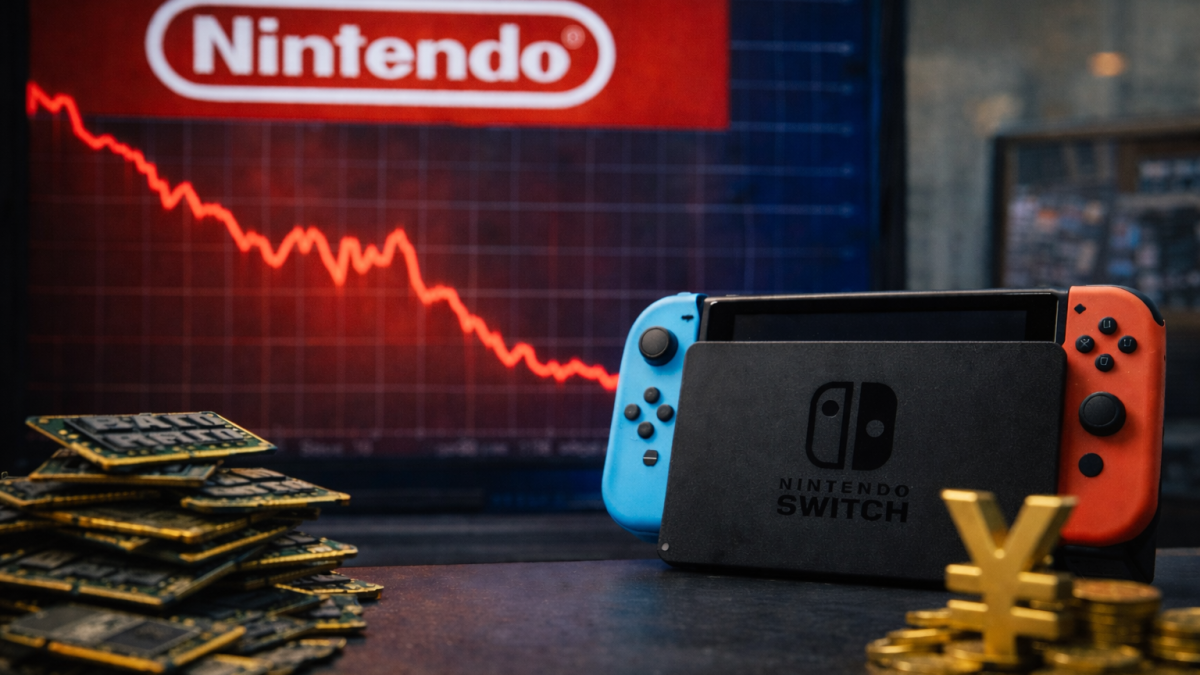
Nintendo shares plunged more than 10% in Tokyo on Wednesday after the gaming giant missed market estimates for quarterly revenue and flagged mounting headwinds from an unprecedented shortage of memory chips, even as profit growth remained strong.
Shares were recently 12% lower at 8,848 yen, extending the stock’s losses to more than 16% so far this year.
The decline followed results released after Tuesday’s market close, which showed sharply higher nine-month earnings but a cautious outlook for the full year.
Revenue miss overshadows profit beat
Nintendo reported a 24% year-on-year jump in profit, supported by continued strength in console sales.
Revenue rose 86%, and the Nintendo Switch remains the company’s best-selling console since its launch in 2017.
Despite the solid earnings performance, investors focused on the revenue shortfall and the company’s decision to maintain its annual forecasts.
Nintendo reiterated that it expects to sell 19 million Switch 2 consoles by the end of March and guided for net profit to climb 25.5% to Y350.00 billion ($2.25 billion) for the year ending March.
Those projections appear conservative.
Net profit for the nine months ended December surged 51% from a year earlier to Y358.86 billion, already exceeding the full-year forecast.
As of December, Nintendo had sold 17.4 million Switch 2 units.
Nomura analyst Naruhito Miki said in a report that Nintendo’s third-quarter operating profit undershot the brokerage’s estimate due to lower sales volumes of Switch 2 software titles, leaving “a somewhat negative impression”.
Memory chip shortages weigh on margins
A key concern for investors is the impact of soaring memory costs on Nintendo’s margins.
The company primarily uses dynamic random access memory (DRAM) in its consoles, a segment facing acute shortages as artificial intelligence and data-centre demand accelerates.
According to a report from market researcher TrendForce, contract prices for conventional DRAM chips in the first quarter are projected to rise 90% to 95% compared with the previous three months.
Last month, a senior semiconductor industry executive told CNBC that the memory chip shortage was expected to persist through 2027.
Andrew Jackson, head of Japanese Equity Strategy at Ortus Advisors, said investors remain concerned about how higher memory prices could affect profitability.
Nintendo President Shuntaro Furukawa acknowledged the risk but sought to reassure markets.
He said Tuesday that memory price rises were not significantly impacting results for the current financial year, though he cautioned they could hurt profitability if elevated costs persist over the longer term.
Switch 2 outlook and content pipeline
Despite the memory crunch, Nintendo maintained its full-year sales forecast for the Switch 2.
However, analysts remain divided on whether upcoming software releases will be sufficient to drive upgrades.
The company plans to release “Mario Tennis Fever” in February and “Pokémon Pokopia” in March, two titles from its flagship franchises.
It also has “The Super Mario Galaxy Movie” scheduled for release in April, following the success of the first Super Mario movie in 2023, which boosted console sales.
James McWhirter, senior analyst at Omdia, told CNBC on Tuesday that 2026 would be a “make-or-break” year for the Switch 2 as Nintendo seeks broader mass-market appeal.
While management struck a cautiously optimistic tone, Furukawa said the company is working with partners to secure long-term, stable memory supply, even as investors remain wary of the broader cost pressures facing hardware makers.
The post Nintendo shares slide after revenue miss as memory chip costs pressure outlook appeared first on Invezz